

Generative Engine Optimization (GEO) is an optimization approach that ensures your brand is cited and recommended in generative AI systems like ChatGPT, Gemini, Perplexity, and Google AI Overviews. By 2026, while AI-driven traffic may be lower in volume, it provides a 4.4 times higher conversion rate compared to traditional organic traffic. GEO is not an alternative to SEO; it is the evolution of SEO in the AI age.
What is included in this content?
Entrance
Arama davranışı sessiz ama köklü şekilde dönüşüyor. HubSpot’un 2026 State of Marketing raporuna göre pazarlamacıların %49’u, AI yanıtları nedeniyle organik arama trafiğinde düşüş yaşadığını belirtiyor. Kullanıcı artık yalnızca “arama sonucu” görmek istemiyor; doğrudan sentezlenmiş cevap bekliyor. Bu değişim, özellikle Google AI Overviews, ChatGPT Search, Gemini ve Perplexity gibi sistemlerin yaygınlaşmasıyla hızlandı.
But there's an important fact: the traffic doesn't disappear. It just disperses.
Today's users:
- It uses AI to perform product comparisons.
- They make purchasing decisions influenced by AI summaries.
- Brands receive AI recommendations before visiting them.
- “Transformation is being achieved through "zero-click" experiences.
Therefore, simply ranking on Google is no longer enough. AI engines need to help you:
- Citing sources
- Adding to recommendation lists
- Presenting it as an expert opinion
- He needs to mention them along with the competitors.
In this guide you will learn the following:
- What exactly is GEO?
- In what ways does it differ from SEO?
- Why it becomes critical in 2026
- Measurable business benefits of GEO
- Efficiency in GEO strategies for your brand.
- Opportunities for the Turkish market
- Practical ways to increase AI visibility
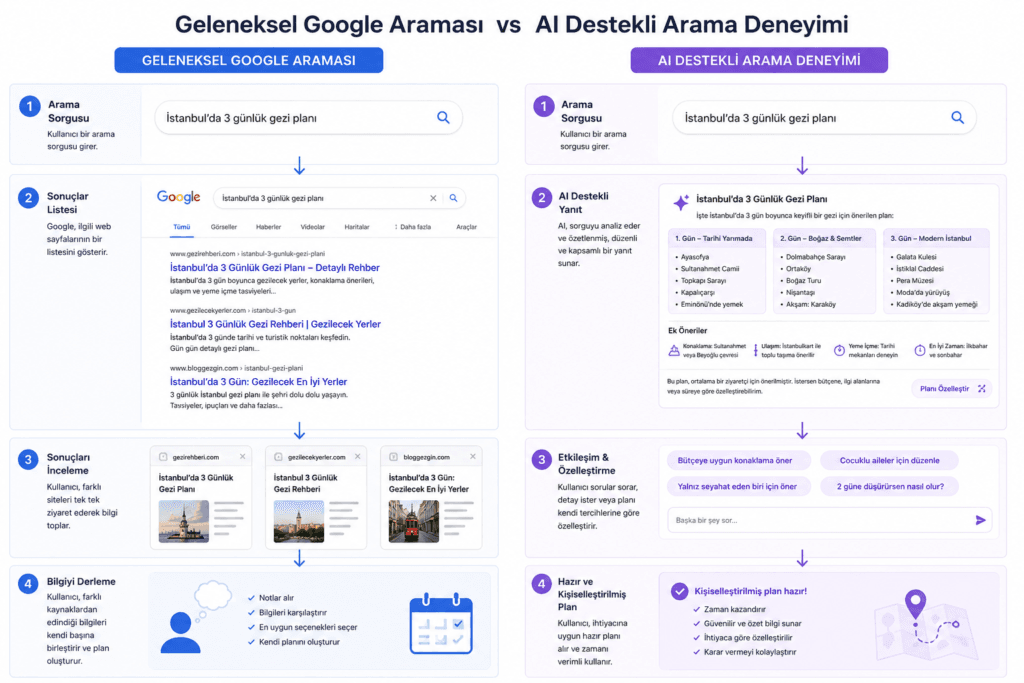
What is GEO? How is GEO different from SEO?
Generative Engine Optimization (GEO) optimizes your brand and content. ChatGPT, Gemini, Perplexity And Google AI Overviews It is an optimization approach that enables the selection, citation, and recommendation of information as a reliable source by generative artificial intelligence systems.
GEO is not a replacement for SEO. GEO builds upon SEO because AI systems still rely heavily on traditional search indexes, high-authority content, and organic ranking signals.
KDD '24 research and AI Overview analyses show that AI systems don't choose content randomly. They prefer structured, reliable, citable, and entity-rich content.
Comparison of GEO and Traditional SEO
| Dimension | Traditional SEO | GEO |
|---|---|---|
| Primary objective | SERP ranking | Citation/reference in AI responses |
| Success metric | Ranking, CTR, organic traffic | Quote frequency, share of AI voice, brand tonality |
| Content format | Keyword-focused pages | Structured data, S&C blocks, entity-rich content. |
| User behavior | Click → visit site → conversion | Synthesized response → clickless conversion |
| Traffic quality | High volume, variable intent | Low volume, high intent. |
| Authority signals | Backlink, domain authority | EEAT, entity authority, third-party betting |
According to Semrush data, AI-routed traffic is more prevalent than traditional organic traffic. 4.4 times higher conversion rate It generates revenue. Therefore, GEO is no longer just a visibility game; it's becoming a strategy that directly generates revenue.
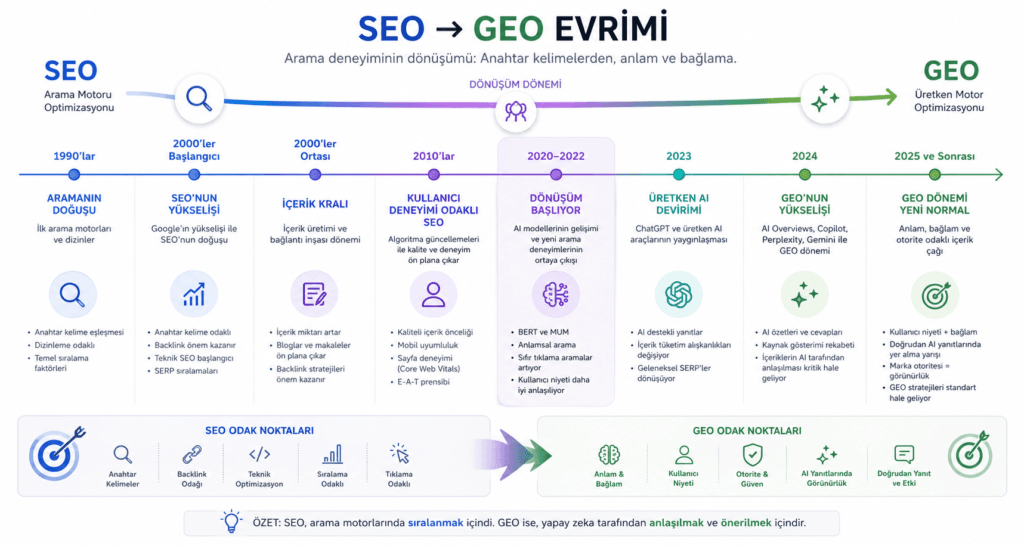
Why Now? Is Urgency Real for GEO?
Yes. Because user behavior changes very rapidly.
HubSpot 2026 State of Marketing According to the report:
- Marketers %49’u They acknowledge that AI responses reduce organic traffic.
- Marketers %58’i AI-driven traffic is said to have a higher purchase intent.
This change isn't happening only on the B2B side. According to Salesforce research:
- Consumers %39’u
- More than half of Generation Z
It actively uses AI tools for product discovery.
More critical data emerges on the visibility side. According to various AI Overview analyses, brands have approximately %26’sı It doesn't appear at all in AI biosummaries. This means that even with strong SEO, you can be invisible in the AI ecosystem.
On the other hand, the link between GEO and SEO is still very strong. Because approximately quotations from AI Overview %99’u, This data comes from the top 10 organic results. This clearly shows the following:
GEO is not an alternative to SEO. GEO is the expansion of SEO in the AI age.
AI systems tend to cite the following types of content more frequently:
- Content that provides clear definitions.
- Structured question-answer blocks
- Statistics from reliable sources.
- Strong entity connections
- Content that clearly signals expertise.
Therefore, brands now have to optimize not just to "get a ranking," but also to "be chosen by AI.".
6 Key Benefits of GEO
1. Provides direct visibility into AI responses.
GEO's biggest advantage is its ability to capture the user's attention at the crucial moment of decision. In traditional search, users first examine the results and then visit the websites. With AI-powered search, however, users often receive direct suggestions.
For example, a user:
“"Which is the best B2B SEO agency in Türkiye?"”
When asked, ChatGPT or Gemini can give you a direct reference. This visibility becomes even more powerful than the classic first-row advantage.
AI systems, in particular:
- Short and clear definitions
- Strong signals of expertise.
- Concrete data
- Comparative content
They use the brands that produce these products more frequently.
Therefore, GEO significantly reduces the distance between high-intent users and brands.
2. Produces Higher Quality Leads
According to Semrush data, AI-routed traffic is more prevalent than traditional organic traffic. 4.4 times higher conversion rate It produces.
The main reason for this is the intensity of intention.
User using AI:
- He defines his problem more clearly.
- It generates more specific queries.
- Makes decisions faster.
- It shortens the research phase with AI.
For example:
“"Agency providing technical consulting for Shopify SEO"”
Someone asking the question, the classic "“What is SEO?”"It is far more valuable than the user who made the search.".
GEO acts as a filter here. The AI system presents the user with already reliable and relevant options. This way, users visiting your site are better prepared.
Especially fast-loading pages and powerful performance optimization studies It helps AI engines perceive the site as more trustworthy.
3. Enables Brand Inclusion in AI Summaries
Today, the vast majority of users aren't researching a single brand. They're asking AI to list the "best options.".
For example, in a search query like "Best performing marketing tools in Türkiye," the AI system often presents several brands in the same answer. However, the ranking isn't the only important factor here:
- In what context were you mentioned?
- How you position yourself against your competitors
- Which attributes are you associated with?
It's happening.
If your GEO strategy isn't strong, AI systems can completely exclude you. This leads to a significant loss of visibility, especially for new brands.
4. Creates an Accumulation of Authority Across Platforms
The AI ecosystem doesn't operate entirely independently. Brands that achieve strong visibility on ChatGPT often begin to appear more frequently in Perplexity, Gemini, and AI Overviews as well.
The reason for this is:
- Shared data sources
- Strong web authority signals
- Repeated entity relationships
- Third-party mentions
It's happening.
For example:
- Reddit discussions
- Webrazzi news
- Podcast guest appearances
- Academic references
- G2 reviews
AI systems enhance brand trust.
Therefore, GEO is not limited to on-page optimization alone. It also requires building a strong authority across the internet.
5. Provides Measurable Visibility with New KPIs
One of GEO's key advantages is that it's measurable. The next generation of GEO metrics includes:
- Citation frequency
- AI share of voice
- AI referral conversion rate
- Brand sentiment
- AI mention consistency
For example, tools like Ahrefs Brand Radar and Otterly.ai now offer:
- Which AI platform you appear on
- Your visibility share compared to competitors.
- What tone of voice did you use when you were mentioned in AI responses?
It can measure.
These metrics are particularly important for management teams to more clearly demonstrate the tangible impact of GEO investment.
6. Generates a Stronger ROI Than Existing Content
One of GEO's greatest advantages is that it doesn't require starting from scratch. Most brands already do this:
- Blog content
- SEO pages
- To the guides
- Comparison content
GEO has invested. GEO restructures these existing assets. For example:
- Add a clear answer within the first 50 words.
- Creating FAQ blocks
- Using Schema Markup
- Updating the statistics
- Converting titles into question format
It can significantly increase the AI visibility of existing content. Therefore, GEO is becoming a layer that strengthens existing SEO investment, rather than a channel requiring an entirely new budget.
6 Key Geo Trends for 2026
1. Transitioning from Keyword Targeting to Topic Authority
AI engines analyze not only specific keywords but also how comprehensively the topic has been covered. Therefore:
- One-page optimization
in its place - Topic cluster approach
It is becoming much more important. AI systems in particular:
- Conceptual scope
- Subheading depth
- Contextual relationship
- Entity links
He prefers strong content.
2. Structured and Concise Content is on the Rise
AI systems love scannable content. Therefore:
- Clear headings
- Brief definitions
- Item lists
- FAQ sections
- Quoteable summaries
It is gaining more importance. In particular, the first 40-60 word blocks of direct response have become critical for AI extraction.
3. Brand Mentions Are Becoming as Important as Backlinks
AI systems don't just count backlinks. They also evaluate who is talking about the brand.
Especially:
- Quora
- Podcasts
- Press publications
It generates a strong entity signal. Therefore, “digital PR” is placed at the center of GEO's strategy.
4. Personalized Content is Becoming the Standard
AI systems try to understand the user's level. Therefore:
- Beginner level
- Expert level
- Purchase stage
- Sector type
Creating content tailored to segments like these is becoming more valuable. A single, general piece of content is often insufficient now.
5. Platform Loyalty is Strengthening
Users are now becoming accustomed to certain AI platforms. For example, some users:
- Perplexity for technical research
- ChatGPT for daily updates
- Gemini for the Google ecosystem
Therefore, brands have to analyze the AI platforms most frequently used by their target audience.
6. Demand for GEO Measurement Software is Increasing.
The GEO tooling market is growing rapidly in 2026. Key tools include:
- OmniSEO
- Otterly.ai
- Rankscale
- Ahrefs Brand Radar
- HubSpot AEO Grader
These tools:
- AI mention tracking
- Competitive analysis
- Share of voice measurement
- Citation monitoring
It meets needs such as these.
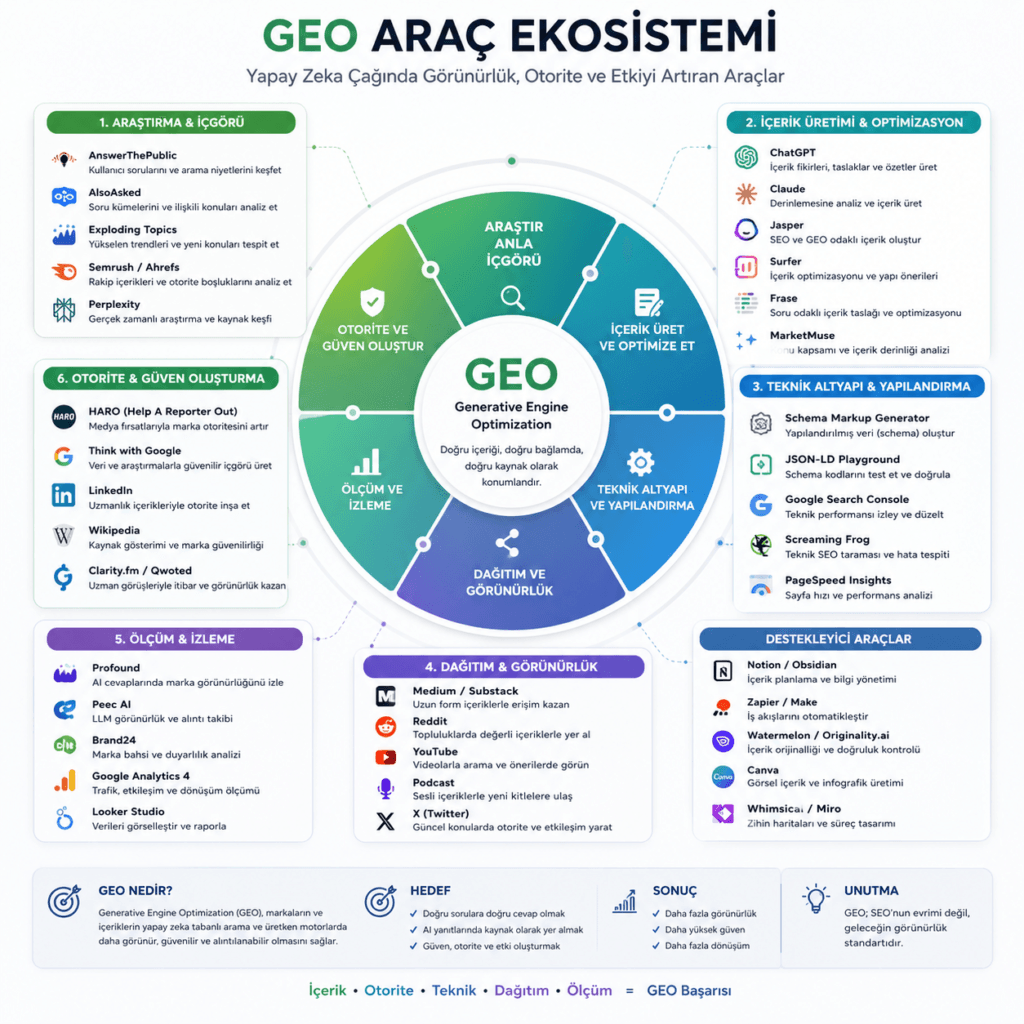
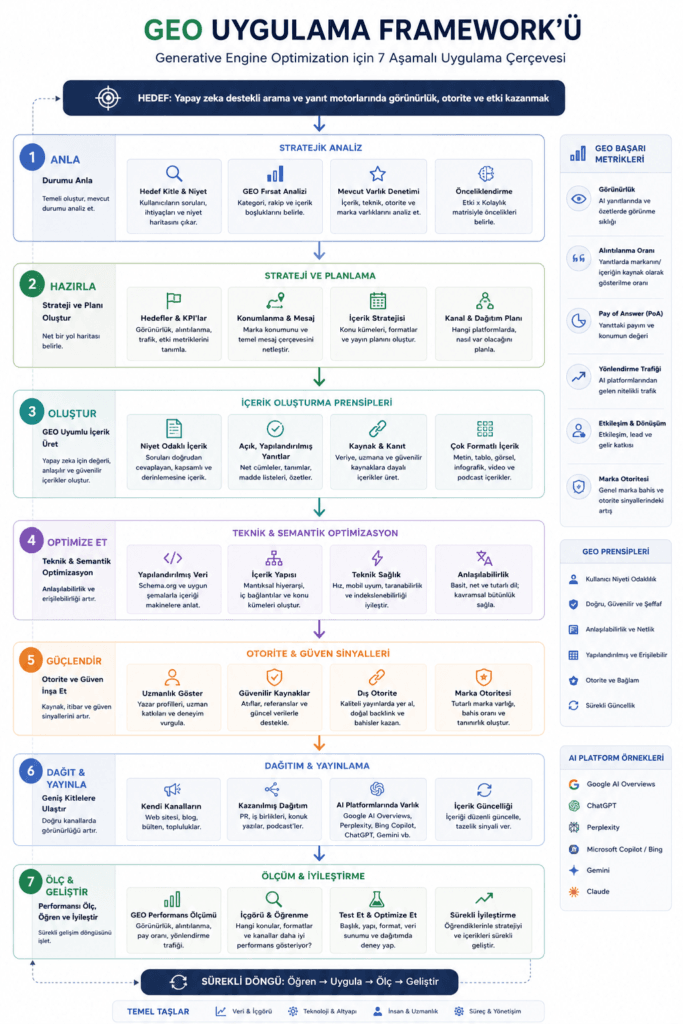
How to Implement GEO? A 7-Step Practical Framework
1. Establish the AI Visibility Baseline
The first step is measurement. Test these queries:
- “The best SEO agency in Türkiye”
- “"The best B2B CRM tools"”
- “"Shopify SEO consulting"”
Behind:
- ChatGPT
- Gemini
- Perplexity
- Google AI Overviews
Check if your brand appears in the results. Document the results in the spreadsheet.
2. Re-engineer Your Most Powerful Ingredients for AI Extraction
These optimizations make a big difference:
- Clear answer in the first 40-60 words.
- H2 headings in question format
- Statistics-focused data blocks
- FAQ sections
- Clear definitions
AI engines particularly prefer content that can be quickly interpreted.
3. Add Critical Schema Markups
The three most important schemas to start with:
- Organization
- Article
- FAQ Page
JSON-LD format is the most practical solution here. Example usage:
{ "@context": "https://schema.org", "@type": "FAQPage" }Schema markup for AI systems:
- To understand your brand
- Deciphering the context of the content
- Establishing entity relationships
It makes it easier.
4. Decompose AI Traffic within GA4
Many teams are unable to accurately measure AI traffic because they haven't built the correct segment structure. Within GA4:
- ChatGPT referral
- Perplexity referral
- Gemini referral
Create the segments. So that:
- Conversion rate
- Session quality
- Lead quality
It becomes much clearer.
5. Build an Entity Authority Outside of Your Own Domain
AI systems don't just look at your own site. They generate strong signals about the following:
- PR news
- Webrazzi mentions
- Podcast submissions
- G2 reviews
- LinkedIn thought leadership content
Content that includes expert opinions is increasingly being cited as a source in AI systems.
6. Make GEO a Standard Process, Not a Separate Process
The most successful teams don't manage GEO as separate teams. Instead:
- Adding GEO criteria to content briefs
- He is adding AI extraction items to his SEO checklist.
- It is restructuring the editorial flow.
This approach provides operational efficiency.
7. Perform Continuous Monitoring and Iteration
AI systems are changing very rapidly. Today's working content:
- It may lose its visibility after 2 months.
- Can be overtaken by new rivals
- It may fall behind due to different formats.
Therefore, the monthly GEO review process becomes critical.
GEO's Biggest Challenges and Solutions
Data Fragmentation
AI systems may experience trust issues if brand information is inconsistently presented online. Solution:
- Use the canonical brand description.
- Add the sameAs schema fields.
- Maintain the same positioning language across all platforms.
Entity Ambiguity
Generic brand names can make things difficult for AI systems.
For example:
“"Nova"”
“"Pulse"”
“"Vision"”
Names like these can be confused with other entities.
Solution:
- Descriptive subheadings
- Specific schema types
- Strong industry context
Use it.
AI Hallucinations
AI systems can sometimes generate inaccurate information about your brand.
Solution:
- Publish updated data.
- Use dated statistics.
- Cite the source.
- Conduct regular monitoring.
Schema Markup Complexity
Many teams are hesitant about the schema implementation process. But here's a starting point:
- JSON-LD
- Google Rich Results Test
- Basic Organization Schema
That will be enough.
A quick start is more valuable than a perfect start.
Measurement Gaps
Classic SEO dashboards cannot measure GEO visibility. Because:
- AI share of voice
- Citation frequency
- AI referral conversion
You need to create new KPIs like these.
Privacy and Compliance Risks
AI systems can bring old content back to the surface. Therefore:
- “"As of 2026"”
- “"According to Q1 2026 data"”
Use temporal markers like these. This approach improves context accuracy.
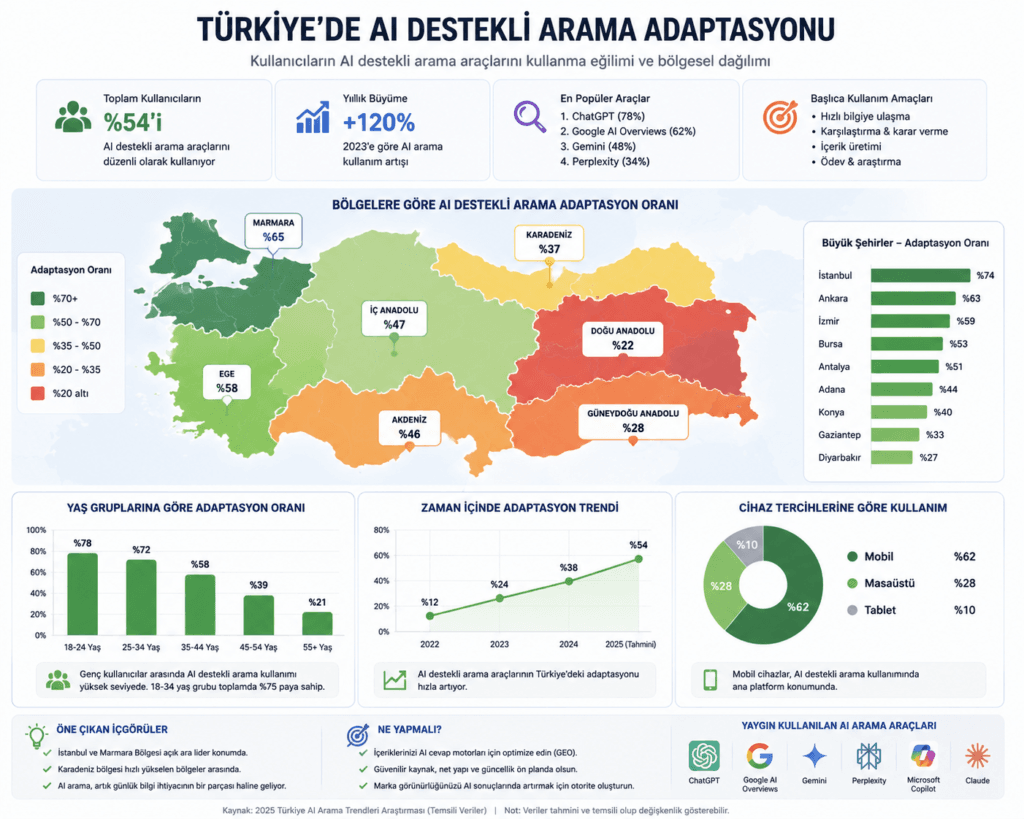
Are there great opportunities for GEO in Türkiye?
Yes. Moreover, compared to Western markets, there are much greater opportunities in Türkiye. The Turkish GEO ecosystem is still in its early stages. Therefore:
- Competition is lower.
- Less structured content.
- Entity authority is less common.
This situation gives brands that act early a significant advantage, especially:
- SaaS companies
- B2B agencies
- E-commerce brands
- Educational platforms
Turkish AI can quickly establish a position in terms of visibility.
The following publications are critical for building strong entity authority in Türkiye:
- Webrazzi
- Marketing Türkiye
- Campaign Türkiye
- Deloitte Türkiye reports
Furthermore, the increasing use of Turkish on Reddit and users' shift towards AI-powered research are accelerating GEO's local impact.
The fastest areas for gains for SMEs:
- FAQ optimization
- Long-tail Turkish content
- Local expertise content
- Using structural schema
That's happening. Especially in niche sectors, competition for Turkish GEO software is still at a low level.
Frequently Asked Questions
How long does it take to see results from GEO?
Rapid technical and content optimizations typically generate initial visibility signals within 2-4 weeks. Strong entity authority and cross-platform visibility, however, begin to accumulate for most brands within 3-6 months.
Can small teams benefit from GEO?
Yes. GEO is not a budget-intensive field, it's a strategy-intensive field. Small teams:
- Structured content creation
- FAQ optimization
- Thought leadership
- AI extraction-focused writing
Thanks to this, they gain an advantage quickly.
How can I reduce AI hallucinations?
The following are effective:
- Current date usage
- Reliable source references
- Consistent brand statements
- Structured data implementation
- Regular AI monitoring
AI systems consider clear and verifiable data to be more reliable.
Should I create new content or update existing content?
The most effective approach often follows a 70/30 model.
- %70 mevcut yüksek trafikli içerikleri optimize edin
- %30 yeni GEO-native içerik üretin
Because strengthening the existing authority often yields faster results.
How can I integrate GEO with Sales and Customer Service?
Sales teams should relay the most frequently asked questions to the content team. Customer service teams, on the other hand, should track which queries users are using in AI tools.
This data:
- FAQ generation
- Intent mapping
- AI visibility strategy
It is very valuable.
GEO: Not the Future, but the Reality of the Present
AI-powered search behavior has now moved beyond the experimental phase. Users can now:
- They are doing product discovery.
- He/She is making a purchase decision.
- Brand comparison
- He/She is seeking expert advice.
And it is doing this increasingly through AI systems.
Therefore, brands that invested early in GEO:
- Stronger AI visibility.
- Higher intent traffic
- Lower acquisition cost
- Stronger brand authority
He is winning.
Here are three concrete steps you can take this week:
- Manually test your brand against 10 critical AI queries.
- Optimize your 5 highest-traffic content items for AI extraction.
- Implement FAQ Page and Organization Schema.
GEO is no longer a "trend of the future." It's a competitive advantage of today.






Trending on social media is one of the most powerful digital strategies that allows brands to reach large audiences quickly. Today, users are not only interested in content…

Digital marketing and social media management play a critical role in enabling brands to gain visibility in the digital world and achieve sustainable growth.
The differences between Meta Business Suite and Business Manager are quite important for businesses managing digital marketing processes. This is because Meta caters to different needs…

While the Apple Vision Pro was something Apple enthusiasts had long awaited, it became the focus of a large audience after its release.

In digital marketing, ensuring customer satisfaction is crucial. Satisfied customers become loyal customers. They help you gain new customers by recommending your brand to others…

With the rapid development of the digital world, choosing a digital agency is becoming a critical decision for brands. Because brands now need to reach their target audience…