

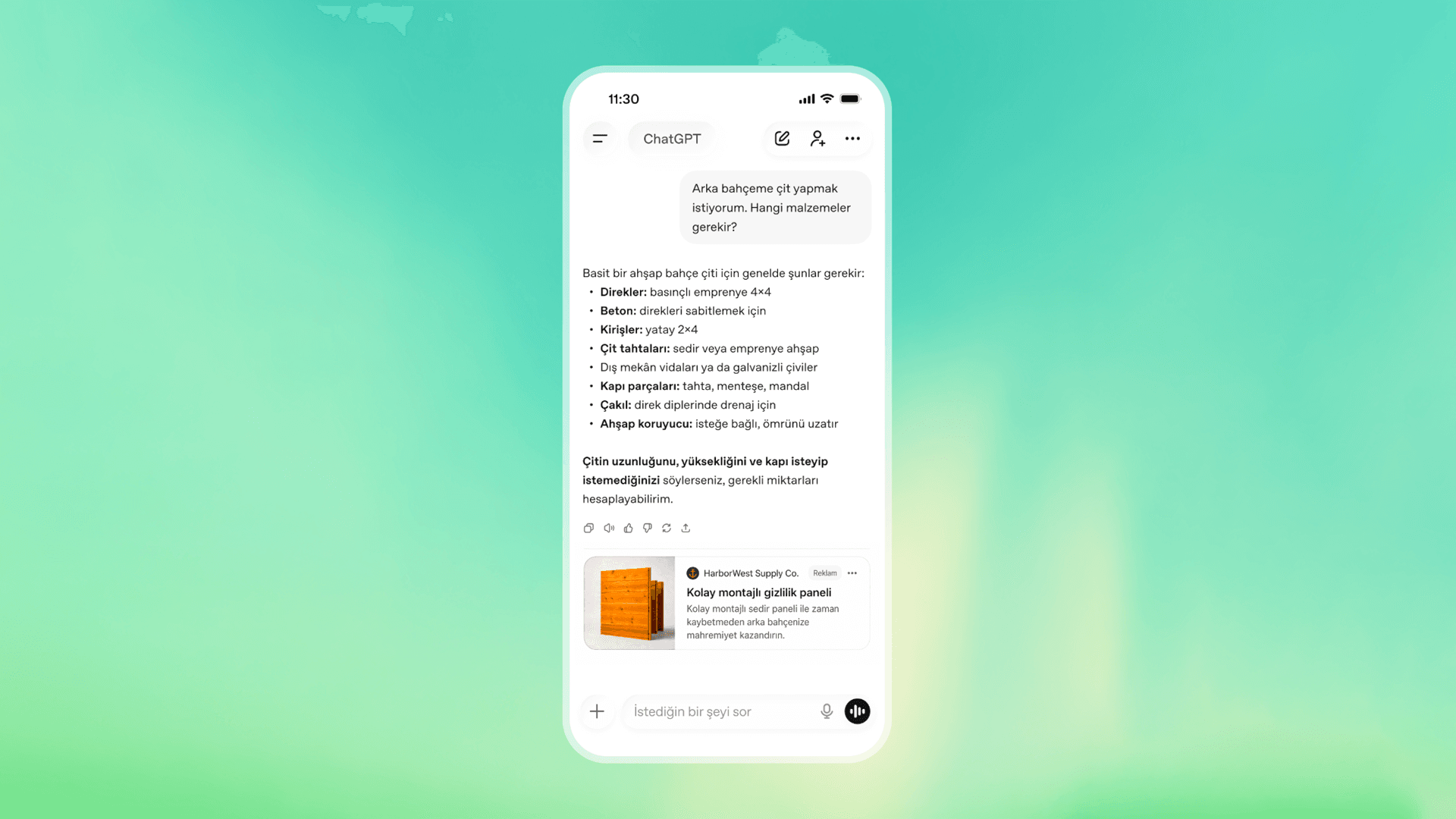
ChatGPT ads, OpenAI offers brands a new digital advertising channel to reach users during research and decision-making processes. OpenAI provides advertisers with the Ads Manager platform for campaign management. In this panel, advertisers select targets, enter budgets, and create ad groups. They also manage team creatives, landing pages, and measurement infrastructure under a single strategy. Unlike traditional search advertising, ChatGPT Ads also emphasizes the context of conversation. This guide covers the ChatGPT Ads system in detail, from basic features to campaign setup.
What is included in this content?
Businesses in Türkiye can also start their advertising process through Ads Manager. OpenAI lists Türkiye among the countries where it offers Ads Manager services. Therefore, a suitable Turkish business can open an advertising account and set up its first campaign. The system includes three main layers: Campaign, Ad Group, and Ad. Advertisers manage their goals, budget, context, and creative decisions within these layers. Additionally, tools like Pixel and Conversions APIs help measure campaign results.
What are ChatGPT Ads?
ChatGPT Ads is an advertising system that allows businesses to reach users with sponsored content within ChatGPT. OpenAI creates a clear distinction between the ad and the ChatGPT response. This allows users to differentiate sponsored content from the regular response. The ad space can include elements such as brand name, title, description, and image. Advertisers can also add a link to the relevant landing page to the ad. This gives brands the opportunity to directly communicate their offer to users in the research process.
The most striking aspect of the system is its ad matching approach. OpenAI doesn't select ads based solely on a few keywords. The system also takes into account the context of the ongoing conversation and the user's intent. Furthermore, the ad headline, ad text, and landing page provide additional signals to the system. Advertisers can share additional context about the product or service using the context hints field. Therefore, a successful advertising strategy requires a broader approach than a classic keyword list.
Are ChatGPT ads available in Türkiye?
Yes, OpenAI currently offers self-service access to Türkiye in its Ads Manager country list. Advertisers need to operate in one of the countries where OpenAI provides its services, and Turkey is among them. Therefore, eligible businesses can open accounts through Ads Manager. However, OpenAI is still developing the platform. Therefore, the company may change campaign options, ad features, and technical tools over time.
Due to its dynamic nature, be sure to check official information before the campaign begins. Budget limits, ad formats, and measurement options, in particular, may change over time. OpenAI may expand Ads Manager with new features. The company may also make changes to existing tools. Therefore, do not rely on old screenshots or social media posts as the sole source of information. Before starting the campaign... OpenAI Ads Manager access list Check it.
How does ChatGPT Ads work?
ChatGPT Ads examines multiple signals together during ad selection. The system first looks at the context of the existing chat and user intent. Then it analyzes the ad's landing page, title, and description. Context hints provided by the advertiser also offer additional context. User ad preferences can also play a role in the ad experience. Thus, OpenAI aims to create a stronger link between relevant ads and the chat.
For example, a user might describe themselves as new to running and looking for running shoes. They could also share their budget, the type of running surface, and how often they'll use the shoes. This conversation reveals a more detailed need than a simple "running shoes" query. The shoe brand could then describe its product using appropriate context hints. The system can then analyze the relationship between this information and the user's need. However, context hints alone do not guarantee ad impressions.
How to run ChatGPT ads?
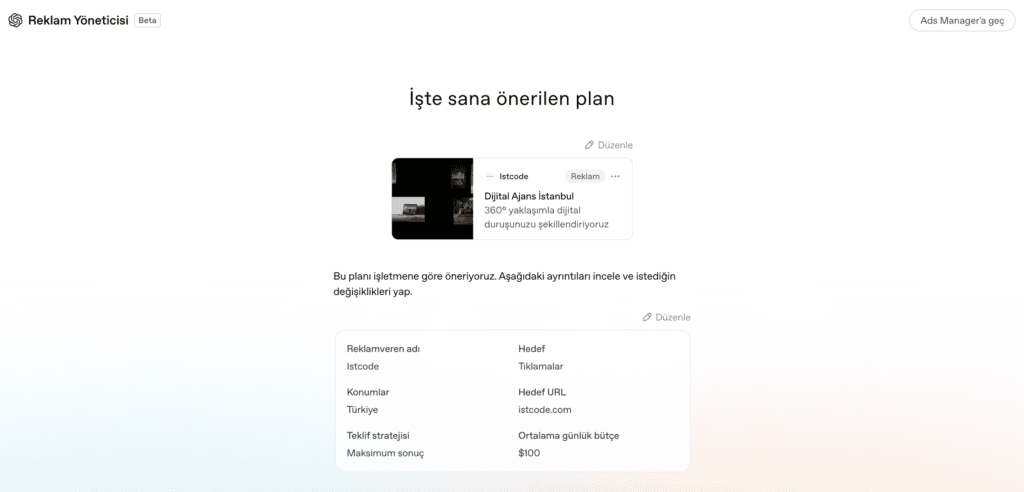
To advertise on ChatGPT, first open your OpenAI Ads Manager account. Then, enter your advertiser information, brand name, and necessary account details. Next, check your billing profile and payment method. After that, select the goal and budget for your first campaign. Plan user intents and context hints at the Ad Group level. Finally, review the ad creative, landing page, and measurement infrastructure before launching your campaign.
1. Open your Ads Manager account.
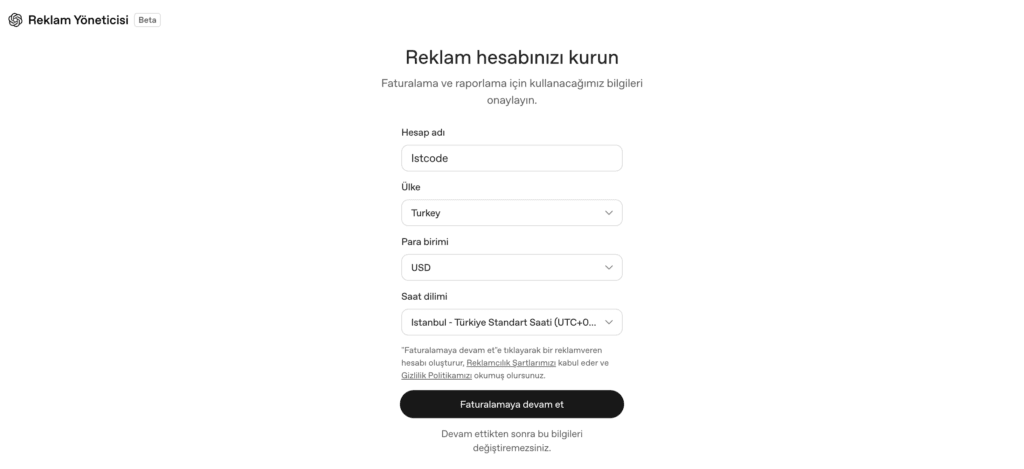
First, create your advertiser account through OpenAI Ads Manager. Enter your company's actual business information into the account fields. Then add your advertiser name and brand image. Check your billing profile and enter your payment method. If a team will be managing the campaigns, grant the team members the necessary account access. This way, you will have completed the basic account-related processes before proceeding with campaign setup.
2. Build the Campaign Structure
Create a new Campaign in Ads Manager to set up the first layer of your ad structure. The Campaign level contains the overall goal and budget of the campaign. You can also plan campaign dates at this level. Add targeting decisions that align with your ad strategy to your campaign plan. Use a name that is easy to understand in reports. Consistent names significantly simplify the reporting process, especially if you manage multiple countries or products.
If you're running ads for the first time, follow the campaign flow in Ads Manager step by step. First, select your campaign goal and enter your budget. Then, go to the Ad Group structure and set up your contextual strategy. In the next step, add the ad text, image, and landing page. Carefully check the information you enter at each stage. This will help reduce problems such as incorrect budget, faulty links, or missing creatives before the campaign starts.
3. Choose your campaign goal.
Align your campaign goals with your business's actual marketing objectives. Check the goals offered by OpenAI in your Ads Manager account at that time. If you want traffic, focus on click-based options. If you want sales or leads, explore conversion-based options. If your goal is brand awareness, look at visibility-based options. Most importantly, clearly define which business outcome you want to grow before launching the campaign.
If you're aiming for brand awareness, prioritize impressions and user engagement. If you want website traffic, analyze click-through quality and post-visit behavior. If you're targeting sales or leads, first establish proper conversion tracking. Also, don't cram different goals into the same campaign. Give each campaign a clear business objective as much as possible. This will make both Ads Manager optimization and your own performance analysis more understandable.
4. Set the Campaign Budget
Next, select your campaign budget. You can see the available budget options for your account in the Ads Manager screen. OpenAI may change minimum amounts depending on the market and currency. Therefore, don't directly transfer a figure you saw in an old guide to your campaign. Check the current minimum budget in your account and set up your test plan accordingly. Then, track your daily spending and make budget decisions based on performance results.
Don't choose your budget solely based on the minimum amount allowed by the platform. Allow sufficient testing space for the campaign to collect meaningful data. However, don't allocate an unnecessarily high budget from day one. Plan a controlled testing period first. Then, regularly compare click, conversion, and cost data. Once you have collected enough data, you can allocate more budget to ad groups that perform strongly.
5. Create the Ad Group Structure
After the Campaign level, move on to the Ad Group structure. Choose a specific theme, need, or user intent for each Ad Group. For example, a digital agency might handle SEO services and performance advertising in different groups. This allows you to focus on different user needs for each service. Design the ad copy and landing page according to the same intent. This structure makes it easier to understand which bid yields the strongest results in campaign analysis.
What are Context Hints and How to Write Them?
Context hints are contextual clues that tell OpenAI about the relationship between conversations related to your product. Advertisers add descriptive statements about the product, service, and user needs to this area. However, context hints don't work like classic exact match keywords. OpenAI treats this information as an additional signal in the ad matching process. Therefore, instead of short keyword lists, describe actual user needs. Clear and concrete statements provide the system with more meaningful context.
For example, simply writing three words like “SEO, advertising, agency” provides weak context. Instead, clearly describe the user's need. “E-commerce brands that want to increase organic Google traffic” offers a more meaningful context. Similarly, you can explain the product category, use case, or customer need. However, don't include popular topics unrelated to your product just for the sake of access. Each context hint should directly relate to your actual offer.
How to Create a ChatGPT Ad?
Create the actual ad creative that the user will see at the ad level. First, choose the core benefit you're offering the user. Then, express this benefit with a short and clear headline. In the description, provide concrete information to support the offer. Add a suitable image to the ad and choose the right landing page. Finally, establish a strong connection between the ad and the landing page message and provide the user with a consistent experience.
When creating creative content, avoid relying too heavily on generic brand slogans. Clearly explain what need your product addresses when users are researching. Also, create several truly different ad variations. You can test the price advantage in one creative, and the product feature or service benefit in another. This allows you to compare the performance of different value propositions. Based on the results, maintain strong messages and test new ideas instead of weak creatives.
What is OpenAI Pixel?
OpenAI Pixel is one of the technical tools that helps you measure post-advertising website actions. For example, you might want to track key actions such as purchases, leads, or registrations. OpenAI also offers a Conversions API for server-side measurement needs. Advertisers can choose the appropriate measurement method according to their technical infrastructure. If you choose both methods, carefully plan the event architecture. This way, you can compare campaign results not only with clicks but also with actual business results.
To measure conversions, first set up your data source within Ads Manager. Then, retrieve your account's Pixel ID and integration information. Pre-select which user actions you want to track on your website. Prioritize real business results such as purchases, form submissions, or registrations. Next, connect Pixel events to these user actions. Finally, run tests and verify that Ads Manager is correctly retrieving event data.
Where do I add the OpenAI Pixel Script code?
Don't just copy a random OpenAI Pixel script from the internet. First, set up your conversion data source in your Ads Manager account. Then, obtain your account's Pixel ID and technical integration information. OpenAI's technical documentation shares the necessary information about the JavaScript Pixel structure. Your developer or technical team can add the necessary script to your website. After that, establish the correct connection between the events you want to measure and actual user actions.
Teams using Google Tag Manager can integrate it with their existing tag management plan. The main goal here isn't just to put JavaScript code on the site. The right event must be triggered at the right time. For example, don't count everyone who visits the form page as a lead. Only trigger the lead event after a successful form submission. Technical measurement plan... Analytics, Pixel, GTM, and reporting. You can improve data quality by implementing it alongside your infrastructure.
What is the purpose of the Conversions API?
The Conversions API helps facilitate the flow of conversion data between your business server and the OpenAI Ads measurement system. In some scenarios, this method can provide additional signals to the browser-side Pixel measurement. The technical team can review both Pixel and Conversions API methods together. If both channels are sending the same conversion, pay attention to the common event ID structure. Also, only share data for which you have the necessary permissions. This will help maintain both measurement quality and data management discipline.
The technical team should plan the conversion architecture before the campaign starts. First, select the events that are valuable to the business. Then, map the data flow on the browser and server sides. Take into account user permissions and current data protection requirements. Next, send test conversions and check the event flow on the Ads Manager side. This way, you can catch key measurement issues before moving on to campaign optimization.
How to Measure ChatGPT Traffic with UTM?
Utilize UTM parameters to view ChatGPT ad traffic separately in your own analytics system. Add consistent source, medium, and campaign values to landing page URLs. This makes it easier to distinguish ChatGPT-sourced visits in analytics tools like GA4. Also, establish a standard naming system for campaign and ad group names. This approach simplifies channel comparisons and prevents different teams from interpreting the same campaign with different names during reporting.
Include the advertising platform's click references in your measurement plan. Maintain the necessary tracking parameters during transitions on the landing page. Have the technical team plan the server-side data flow in accordance with these parameters. However, don't equate UTM parameters with the platform's own click references. UTM values primarily contribute to your own analytics reports. The platform's own references, on the other hand, can help you measure the relationship between advertising and conversions.
Which metrics should you track in ChatGPT Ads performance?
Ads Manager offers various metrics to help you understand campaign performance. Regularly track impression and click counts. Examine CTR data to understand the relationship between ad message and user interest. Compare spending and cost metrics along with the results. If you've set up conversion tracking, focus specifically on real business results. This will make it easier to identify ads that deliver value to your business, rather than just generating cheap traffic.
A high CTR alone doesn't necessarily mean a successful campaign. Ads might get a lot of clicks, but the landing page might not generate sales. Similarly, a low CPC doesn't always mean high-quality users. Therefore, examine the ad metric in conjunction with the subsequent steps of the sales funnel. Also consider results like lead quality, purchase cost, and acquisition cost. Meta and Google Ads management Compare ChatGPT results with data targeting the same business objective.
What is the difference between ChatGPT Ads and Google Ads and Meta Ads?
Google, Meta, and ChatGPT can capture powerful signals at different user moments. Google Ads offers a strong channel based on search query and business intent in most scenarios. Meta Ads leverages social discovery and platform behavior extensively. ChatGPT Ads, on the other hand, uses the context of the current chat as a crucial signal in ad matching. Because the user can describe their needs in detail, the chat can offer additional context. This feature gives ChatGPT Ads a unique advertising experience.
Therefore, don't directly replace Google or Meta with ChatGPT Ads. First, measure each channel's role in the customer journey separately. Develop appropriate ad creatives for each platform. Ensure consistent conditions for the landing page experience. Then, compare click, conversion, and acquisition costs. After collecting sufficient data, you can reallocate the media budget across channels based on actual business performance.
Does ChatGPT read chat ads?
OpenAI clarifies that it does not give advertisers direct access to users' private ChatGPT conversations. The company also states that it does not sell user data to advertisers. Its advertising system can take the context of the current chat into account when selecting appropriate ads. However, advertisers cannot directly see a user's private chat history. OpenAI establishes a clear distinction between sponsored content and ChatGPT responses, allowing users to see the difference between a normal response and commercial content.
Users can also have some control over their ad preferences. OpenAI offers user controls for the advertising experience. The company states that it prioritizes user trust when developing its advertising system. Brands should also consider this approach in their own campaign strategies. Avoid misleading promises and creatives that could damage user trust. For long-term performance, consider ad relevance in conjunction with a strong brand experience.
How should you proceed with your first ChatGPT Ads campaign?
Plan the initial campaign as a controlled test rather than a large-scale media investment. First, choose a single business objective. Then, create a landing page and conversion event suitable for that objective. Separate user intents into several meaningful Ad Groups. Write clear contextual hints for each group. Finally, add different creatives, complete Pixel and UTM checks, and launch the campaign with a controlled budget.
Don't draw definitive conclusions from the first few data points. Allow the campaign sufficient time to collect meaningful data. Then, examine performance differences at the Ad Group level. Compare which ad messages generate stronger clicks and conversions. Instead of constantly making minor changes to weak creatives, also test new value propositions. Once you have collected enough data, allocate the budget to campaign structures that produce stronger commercial results.
How to Build an Evergreen Strategy for ChatGPT Ads?
ChatGPT ads Because it's a rapidly evolving product, outdated information may quickly become obsolete. OpenAI regularly updates its Ads Manager features. The company may add new goals, measurement tools, or ad options. Also, minimum budgets may vary depending on the market and currency. Therefore, don't rely solely on old guidelines when setting up campaigns. Regularly check the current options on the Ads Manager screen and OpenAI's official documentation.
On the SEO side, don't create separate, short pages for every single query. First, strengthen this guide as the main source page for ChatGPT Ads. Then, you can explain the advertising process in more detail in a separate implementation guide. You can also prepare a technical guide for OpenAI Pixel and conversion tracking. Ad costs can become a separate content item once sufficient data is generated. This way, as your content set grows, you can prevent similar search intents from competing with each other.
What should you check before starting ChatGPT Ads?
First, verify the company information in your advertiser account. Then, complete your billing profile and payment method. Align your campaign goal with your actual business results. Plan the Ad Group structure according to customer needs. Write context hints that are clear, natural, and relevant to your product. Finally, launch the campaign by testing the creatives, landing page, Pixel events, Conversions API flow, and UTM parameters.
Taking an early step in a new advertising channel doesn't create a competitive advantage on its own. The real advantage lies in accurate measurement and rapid learning. Therefore, clearly define your success metrics before starting the campaign. Decide which conversions are valuable for your business. Compare ChatGPT, Google, and Meta results within the same business objective framework. Then, manage your budget based on actual customer acquisition and conversion data, not just estimates.
If you want to test ChatGPT Ads for your brand, don't just open an ad account and enter a budget. First, plan the campaign architecture, context hints structure, and creative strategy together. Then, fully set up the Pixel and conversion measurement infrastructure. Collect data with a controlled budget and compare the results with your other ad channels. Our team can plan this process together with your brand's existing performance strategy. Contact us today, share your brief, and get a quote for your measurable ChatGPT Ads campaign plan.





Improving your LinkedIn performance is a critical goal, especially for brands seeking sustainable growth in B2B marketing. With the right strategy, you can achieve results not only...

These 11 ways to grow your social media audience are critical for anyone looking to increase their digital visibility and build sustainable engagement….

Instagram is one of the most important social media platforms, thanks to its user base and the features it develops every day. It offers a variety of fun features for its users…

Why do agencies play a strategic role for brands? The most effective strategies used by agencies enable brands to grow faster and more controllably in the digital world…

The question of how to gain followers on social media has been asked by almost everyone. From novice content creators to corporate brands, everyone's goal is the same: More...

Google announced its latest update, stating that it will prioritize original content over SEO-focused content. The benefit of this update is for users…